Roy Lichtenstein Artwork Roy Fox Lichtenstein What Kind of Art Media Did He Use
| Roy Lichtenstein | |
|---|---|
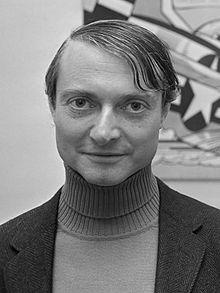 Lichtenstein in 1967 | |
| Built-in | Roy Fox Lichtenstein (1923-10-27)Oct 27, 1923 New York City, U.Southward. |
| Died | September 29, 1997(1997-09-29) (aged 73) New York City, U.Southward. |
| Education | Timothy Dwight Schoolhouse |
| Alma mater | Ohio Land Academy |
| Known for | Painting, sculpture |
| Movement | Pop art |
| Spouse(s) |
|
| Patron(s) | Gunter Sachs |
Roy Fox Lichtenstein [1] (; October 27, 1923 – September 29, 1997) was an American pop artist. During the 1960s, along with Andy Warhol, Jasper Johns, and James Rosenquist among others, he became a leading figure in the new fine art movement. His work defined the premise of popular art through parody.[2] Inspired by the comic strip, Lichtenstein produced precise compositions that documented while they parodied, often in a natural language-in-cheek style. His work was influenced by popular advertizement and the comic book style. His artwork was considered to exist "disruptive".[3] He described pop art as "not 'American' painting simply really industrial painting".[4] His paintings were exhibited at the Leo Castelli Gallery in New York City.
Whaam! and Drowning Girl are generally regarded equally Lichtenstein's about famous works.[five] [vi] [7] Drowning Girl, Whaam!, and Await Mickey are regarded as his about influential works.[viii] His most expensive piece is Masterpiece, which was sold for $165 meg in January 2017.[9]
Early years
Lichtenstein was born into an upper middle class German-Jewish family in New York Urban center.[1] [10] [11] His father, Milton, was a existent estate banker, his mother, Beatrice (Werner), a homemaker.[12] He was raised on New York City'southward Upper West Side and attended public school until the age of twelve. He and so attended New York'south Dwight School, graduating from there in 1940. Lichtenstein first became interested in art and blueprint every bit a hobby, through school.[13] He was an avid jazz fan, frequently attending concerts at the Apollo Theater in Harlem.[xiii] He oft drew portraits of the musicians playing their instruments.[xiii] In his last year of loftier school, 1939, Lichtenstein enrolled in summer classes at the Art Students League of New York, where he worked under the tutelage of Reginald Marsh.[14]
Career

Lichtenstein then left New York to study at Ohio Land University, which offered studio courses and a degree in fine arts.[1] His studies were interrupted by a three-twelvemonth stint in the Army during and afterwards Globe War II between 1943 and 1946.[i] After beingness in preparation programs for languages, engineering, and pilot grooming, all of which were cancelled, he served equally an orderly, draftsman, and artist.[1]
Lichtenstein returned dwelling house to visit his dying father and was discharged from the Regular army with eligibility for the Grand.I. Bill.[xiii] He returned to studies in Ohio under the supervision of one of his teachers, Hoyt L. Sherman, who is widely regarded to have had a significant impact on his future work (Lichtenstein would later proper name a new studio he funded at OSU as the Hoyt L. Sherman Studio Fine art Center).[fifteen]
Lichtenstein entered the graduate program at Ohio State and was hired as an art teacher, a mail he held on and off for the next 10 years. In 1949 Lichtenstein received a Master of Fine Arts degree from Ohio State University.
In 1951, Lichtenstein had his first solo exhibition at the Carlebach Gallery in New York.[one] [16] He moved to Cleveland in the same twelvemonth, where he remained for six years, although he often traveled dorsum to New York. During this time he undertook jobs as varied as a draftsman to a window decorator in betwixt periods of painting.[i] His work at this time fluctuated betwixt Cubism and Expressionism.[thirteen] In 1954, his first son, David Hoyt Lichtenstein, now a songwriter, was born. His 2d son, Mitchell Lichtenstein, was born in 1956.[17]
In 1957, he moved dorsum to upstate New York and began instruction again.[4] It was at this time that he adopted the Abstract Expressionism fashion, being a belatedly convert to this style of painting.[18] Lichtenstein began teaching in upstate New York at the State Academy of New York at Oswego in 1958. Nigh this time, he began to incorporate hidden images of drawing characters such as Mickey Mouse and Bugs Bunny into his abstract works.[19]
Rise to prominence
In 1960, he started educational activity at Rutgers University where he was heavily influenced by Allan Kaprow, who was also a instructor at the academy. This environs helped reignite his interest in Proto-pop imagery.[ane] In 1961, Lichtenstein began his first popular paintings using cartoon images and techniques derived from the appearance of commercial press. This phase would keep to 1965, and included the employ of ad imagery suggesting consumerism and homemaking.[13] His kickoff work to feature the large-calibration utilize of difficult-edged figures and Ben-Day dots was Look Mickey (1961, National Gallery of Art, Washington, D.C.).[20] This piece came from a claiming from one of his sons, who pointed to a Mickey Mouse comic book and said; "I bet you lot can't paint as expert as that, eh, Dad?"[21] In the aforementioned twelvemonth he produced half dozen other works with recognizable characters from gum wrappers and cartoons.[19]
In 1961, Leo Castelli started displaying Lichtenstein's work at his gallery in New York. Lichtenstein had his first i-homo show at the Castelli gallery in 1962; the entire collection was bought past influential collectors before the bear witness fifty-fifty opened.[1] A grouping of paintings produced between 1961 and 1962 focused on lone household objects such equally sneakers, hot dogs, and golf game assurance.[22] In September 1963 he took a get out of absenteeism from his instruction position at Douglass College at Rutgers.[23]
His works were inspired past comics featuring war and romantic stories "At that time," Lichtenstein afterward recounted, "I was interested in annihilation I could apply as a subject that was emotionally strong – commonly love, war, or something that was highly charged and emotional subject matter to be opposite to the removed and deliberate painting techniques".[24]
Menstruum of Lichtenstein'due south highest profile

It was at this time that Lichtenstein began to discover fame non just in America merely worldwide. He moved dorsum to New York to be at the center of the fine art scene and resigned from Rutgers University in 1964 to concentrate on his painting.[25] Lichtenstein used oil and Magna (early on acrylic) paint in his all-time known works, such every bit Drowning Daughter (1963), which was appropriated from the lead story in DC Comics' Secret Hearts No. 83. (Drowning Girl now hangs in the Museum of Mod Art, New York.[26]) Drowning Girl besides features thick outlines, assuming colors and Ben-Mean solar day dots, as if created past photographic reproduction. Of his own piece of work Lichtenstein would say that the Abstract Expressionists "put things down on the sail and responded to what they had done, to the color positions and sizes. My style looks completely different, but the nature of putting down lines pretty much is the same; mine but don't come up out looking calligraphic, like Pollock'south or Kline's."[27]
Rather than try to reproduce his subjects, Lichtenstein's work tackled the way in which the mass media portrays them. He would never take himself too seriously, however, proverb: "I think my work is different from comic strips – only I wouldn't call information technology transformation; I don't retrieve that whatever is meant by it is of import to art."[28] When Lichtenstein's work was kickoff exhibited, many art critics of the time challenged its originality. His work was harshly criticized equally vulgar and empty. The title of a Life magazine article in 1964 asked, "Is He the Worst Artist in the U.S.?"[29] Lichtenstein responded to such claims by offering responses such as the following: "The closer my work is to the original, the more than threatening and critical the content. Even so, my piece of work is entirely transformed in that my purpose and perception are entirely different. I remember my paintings are critically transformed, simply it would be hard to prove information technology by whatsoever rational line of argument."[thirty] He discussed experiencing this heavy criticism in an interview with April Bernard and Mimi Thompson in 1986. Suggesting that it was at times difficult to be criticized, Lichtenstein said, "I don't doubt when I'm actually painting, it'south the criticism that makes you wonder, information technology does."[31]
His nigh celebrated image is arguably Whaam! (1963, Tate Modern, London[32]), one of the primeval known examples of pop art, adjusted from a comic-book panel drawn past Irv Novick in a 1962 issue of DC Comics' All-American Men of State of war.[33] The painting depicts a fighter aircraft firing a rocket into an enemy airplane, with a red-and-yellow explosion. The cartoon style is heightened past the use of the onomatopoeic lettering "Whaam!" and the boxed explanation "I pressed the fire control ... and ahead of me rockets blazed through the sky ..." This diptych is large in scale, measuring 1.7 x iv.0 chiliad (v ft 7 in 10 13 ft four in).[32] Whaam follows the comic strip-based themes of some of his previous paintings and is part of a body of war-themed piece of work created between 1962 and 1964. It is ane of his two notable large war-themed paintings. It was purchased by the Tate Gallery in 1966, subsequently being exhibited at the Leo Castelli Gallery in 1963, and (now at the Tate Modern) has remained in their collection e'er since. In 1968, the Darmstadt entrepreneur Karl Ströher acquired several major works past Lichtenstein, such equally Nurse (1964), Compositions I (1964), We rose up slowly (1964) and Yellowish and Greenish Brushstrokes (1966). Afterwards being on loan at the Hessiches Landesmuseum Darmstadt for several years, the founding manager of the Museum für Moderne Kunst Frankfurt, Peter Iden, was able to acquire a total of 87 works[34] from the Ströher collection[35] in 1981, primarily American Pop Art and Minimal Art for the museum nether construction until 1991.[36]
Lichtenstein began experimenting with sculpture around 1964, demonstrating a knack for the course that was at odds with the insistent flatness of his paintings. For Head of Girl (1964), and Head with Cherry-red Shadow (1965), he collaborated with a ceramicist who sculpted the form of the head out of dirt. Lichtenstein then practical a glaze to create the same sort of graphic motifs that he used in his paintings; the awarding of black lines and Ben-Solar day dots to 3-dimensional objects resulted in a flattening of the course.[37]
Most of Lichtenstein'due south best-known works are relatively close, but not exact, copies of comic book panels, a discipline he largely abandoned in 1965, though he would occasionally incorporate comics into his work in dissimilar ways in later decades. These panels were originally fatigued by such comics artists equally Jack Kirby and DC Comics artists Russ Heath, Tony Abruzzo, Irv Novick, and Jerry Grandenetti, who rarely received any credit. Jack Cowart, executive director of the Lichtenstein Foundation, contests the notion that Lichtenstein was a copyist, saying: "Roy's work was a wonderment of the graphic formulae and the codification of sentiment that had been worked out past others. The panels were inverse in calibration, colour, treatment, and in their implications. There is no exact re-create."[38] Notwithstanding, some[39] have been critical of Lichtenstein'southward use of comic-book imagery and fine art pieces, peculiarly insofar as that use has been seen as endorsement of a patronizing view of comics by the art mainstream;[39] cartoonist Fine art Spiegelman commented that "Lichtenstein did no more than or less for comics than Andy Warhol did for soup."[39]
Lichtenstein'southward works based on enlarged panels from comic books engendered a widespread debate about their claim as art.[40] [41] Lichtenstein himself admitted, "I am nominally copying, just I am really restating the copied thing in other terms. In doing that, the original acquires a totally different texture. It isn't thick or thin brushstrokes, it's dots and flat colours and unyielding lines."[42] Eddie Campbell blogged that "Lichtenstein took a tiny picture, smaller than the palm of the hand, printed in iv colour inks on newsprint and blew information technology upwards to the conventional size at which 'art' is made and exhibited and finished it in paint on canvas."[43] With regard to Lichtenstein, Nib Griffith one time said, "There's high fine art and there's low fine art. And then there's high art that tin can take low art, bring it into a high art context, appropriate it and elevate information technology into something else."[44]
Although Lichtenstein'southward comic-based work gained some acceptance, concerns are still expressed by critics who say Lichtenstein did not credit, pay whatever royalties to, or seek permission from the original artists or copyright holders.[45] [46] In an interview for a BBC Four documentary in 2013, Alastair Sooke asked the comic book artist Dave Gibbons if he considered Lichtenstein a plagiarist. Gibbons replied: "I would say 'copycat'. In music for instance, you lot can't just whistle somebody else's tune or perform somebody else'due south melody, no affair how badly, without somehow crediting and giving payment to the original artist. That's to say, this is 'WHAAM! past Roy Lichtenstein, after Irv Novick'."[47] Sooke himself maintains that "Lichtenstein transformed Novick's artwork in a number of subtle just crucial ways."[48]
Journal founder, City Academy London lecturer and University Higher London PhD, Ernesto Priego notes that Lichtenstein'southward failure to credit the original creators of his comic works was a reflection on the conclusion by National Journal Publications, the predecessor of DC Comics, to omit any credit for their writers and artists:
As well embodying the cultural prejudice confronting comic books as vehicles of art, examples like Lichtenstein'due south cribbing of the vocabulary of comics highlight the importance of taking publication format in consideration when defining comics, equally well as the political economy implied past specific types of historical publications, in this case the American mainstream comic book. To what extent was National Periodical Publications (later DC) responsible for the rejection of the roles of Kanigher and Novick equally artists in their own right by not granting them total authorial credit on the publication itself?"[49]
Furthermore, Campbell notes that there was a fourth dimension when comic artists often declined attribution for their work.[43]
In an business relationship published in 1998, Novick said that he had met Lichtenstein in the regular army in 1947 and, as his superior officer, had responded to Lichtenstein's tearful complaints almost the menial tasks he was assigned past recommending him for a better job.[fifty] Jean-Paul Gabilliet has questioned this account, saying that Lichtenstein had left the regular army a yr before the time Novick says the incident took identify.[51] Bart Beaty, noting that Lichtenstein had appropriated Novick for works such as Whaam! and Okay Hot-Shot, Okay!, says that Novick'southward story "seems to be an endeavor to personally diminish" the more famous artist.[50]
In 1966, Lichtenstein moved on from his much-celebrated imagery of the early 1960s, and began his Modern Paintings series, including over 60 paintings and accompanying drawings. Using his characteristic Ben-Solar day dots and geometric shapes and lines, he rendered incongruous, challenging images out of familiar architectural structures, patterns borrowed from Art Déco and other subtly evocative, often sequential, motifs.[52] The Mod Sculpture series of 1967–viii made reference to motifs from Art Déco architecture.[53]
Later work

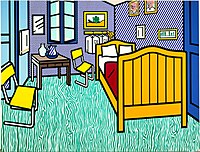
In the early on 1960s, Lichtenstein reproduced masterpieces by Cézanne, Mondrian and Picasso earlier embarking on the Brushstrokes series in 1965.[54] Lichtenstein connected to revisit this theme later in his career with works such equally Sleeping room at Arles that derived from Vincent van Gogh's Bedroom in Arles.
In 1970, Lichtenstein was commissioned by the Los Angeles Canton Museum of Fine art (within its Art and Technology programme adult between 1967 and 1971) to make a film. With the help of Universal Picture Studios, the artist conceived of, and produced, Iii Landscapes, a film of marine landscapes, directly related to a series of collages with landscape themes he created betwixt 1964 and 1966.[55] Although Lichtenstein had planned on producing 15 short films, the 3-screen installation – made with New York-based independent filmmaker Joel Freedman – turned out to be the artist's simply venture into the medium.[56]
Too in 1970, Lichtenstein purchased a old railroad vehicle firm in Southampton, Long Isle, built a studio on the holding, and spent the rest of the 1970s in relative seclusion.[57] In the 1970s and 1980s, his style began to loosen and he expanded on what he had washed before. Lichtenstein began a series of Mirrors paintings in 1969. By 1970, while continuing on the Mirrors serial, he started work on the subject of entablatures. The Entablatures consisted of a first series of paintings from 1971 to 1972, followed past a 2d serial in 1974–76, and the publication of a serial of relief prints in 1976.[58] He produced a series of "Artists Studios" which incorporated elements of his previous piece of work. A notable example being Creative person's Studio, Await Mickey (1973, Walker Art Centre, Minneapolis) which incorporates five other previous works, fitted into the scene.[1]
During a trip to Los Angeles in 1978, Lichtenstein was fascinated past lawyer Robert Rifkind'south collection of German Expressionist prints and illustrated books. He began to produce works that borrowed stylistic elements found in Expressionist paintings. The White Tree (1980) evokes lyric Der Blaue Reiter landscapes, while Dr. Waldmann (1980) recalls Otto Dix'due south Dr. Mayer-Hermann (1926). Small colored-pencil drawings were used as templates for woodcuts, a medium favored past Emil Nolde and Max Pechstein, as well as Dix and Ernst Ludwig Kirchner.[59] Too in the late 1970s, Lichtenstein'south style was replaced with more surreal works such as Pow Wow (1979, Ludwig Forum für Internationale Kunst, Aachen). A major series of Surrealist-Pop paintings from 1979 to 1981 is based on Native American themes.[lx] [61] These works range from Amerind Figure (1981), a stylized life-size sculpture reminiscent of a streamlined totem pole in black-patinated bronze, to the awe-inspiring wool tapestry Amerind Landscape (1979). The "Indian" works took their themes, similar the other parts of the Surrealist series, from gimmicky fine art and other sources, including books on American Indian pattern from Lichtenstein's small library.[62]
Lichtenstein's Still Life paintings, sculptures and drawings, which bridge from 1972 through the early 1980s, cover a diversity of motifs and themes, including the about traditional such equally fruit, flowers, and vases.[63] In 1983 Lichtenstein made 2 anti-apartheid posters, just titled "Against Apartheid".[64] [65] In his Reflection series, produced betwixt 1988 and 1990, Lichtenstein reused his ain motifs from previous works.[66] Interiors (1991–1992) is a series of works depicting bland domestic environments inspired by furniture ads the artist found in telephone books or on billboards.[67] Having garnered inspiration from the monochromatic prints of Edgar Degas featured in a 1994 exhibition at the Metropolitan Museum of Fine art in New York, the motifs of his Landscapes in the Chinese Fashion series are formed with simulated Benday dots and cake contours, rendered in hard, vivid color, with all traces of the manus removed.[68] The nude is a recurring element in Lichtenstein's piece of work of the 1990s, such as in Collage for Nude with Red Shirt (1995).
In addition to paintings and sculptures, Lichtenstein also made over 300 prints, mostly in screenprinting.[69]
Commissions

Group five Racing Version of BMW 320i, painted in 1977 by Roy Lichtenstein

In 1969, Lichtenstein was deputed by Gunter Sachs to create Composition and Leda and the Swan, for the collector's Pop Art sleeping accommodation suite at the Palace Hotel in St. Moritz. In the tardily 1970s and during the 1980s, Lichtenstein received major commissions for works in public places: the sculptures Lamp (1978) in St. Mary's, Georgia; Mermaid (1979) in Miami Embankment; the 26 anxiety tall Brushstrokes in Flight (1984, moved in 1998) at Port Columbus International Airport; the v-storey loftier Mural with Blue Brushstroke (1984–85) at the Equitable Center, New York; and El Cap de Barcelona (1992) in Barcelona.[53] In 1994, Lichtenstein created the 53-human foot-long, enamel-on-metal Times Square Mural in Times Square subway station.[70] In 1977, he was commissioned by BMW to paint a Group v Racing Version of the BMW 320i for the third installment in the BMW Art Auto Projection. The DreamWorks Records logo was his last completed projection.[1] "I'm not in the business of doing anything similar that (a corporate logo) and don't intend to practice it again," allows Lichtenstein. "But I know Mo Ostin and David Geffen and it seemed interesting."[71]
Recognition
- 1977 Skowhegan Medal for Painting, Skowhegan School, Skowhegan, Maine.
- 1979 American Academy of Arts and Letters, New York.
- 1989 American Academy in Rome, Rome, Italia. Artist in residence.
- 1991 Creative Arts Award in Painting, Brandeis University, Waltham, Massachusetts.
- 1993 Amici de Barcelona, from Mayor Pasqual Maragall, Fifty'Alcalde de Barcelona.
- 1995 Kyoto Prize, Inamori Foundation, Kyoto, Japan.
- 1995 National Medal of the Arts, Washington D.C.
Lichtenstein received numerous Honorary Doctorate degrees from, among others, the George Washington University (1996), Bard Higher, Majestic College of Art (1993), Ohio State Academy (1987), Southampton College (1980), and the California Institute of the Arts (1977). He also served on the board of the Brooklyn Academy of Music.[57]
Personal life
In 1949, Lichtenstein married Isabel Wilson, who previously had been married to Ohio creative person Michael Sarisky.[72] However, the vicious upstate winters took a price on Lichtenstein and his wife,[73] after he began didactics at the Country Academy of New York at Oswego in 1958. The couple sold the family home in Highland Park, New Jersey, in 1963[74] and divorced in 1965.
Lichtenstein married his second wife, Dorothy Herzka, in 1968.[75] In 1966, they rented a house in Southampton, New York that Larry Rivers had bought around the corner from his own business firm.[76] Three years later, they bought a 1910 railroad vehicle business firm facing the sea on Gin Lane.[76] From 1970 until his expiry, Lichtenstein split his time between Manhattan and Southampton.[77] He also had a home on Captiva Isle.[78]
In 1991, Lichtenstein began an affair with vocaliser Erica Wexler who became the muse for his Nudes series including the 1994 "Nudes with Embankment Ball." She was 22 and he was 68.[79] The affair lasted until 1994 and was over when Wexler went to England with future husband Andy Partridge of XTC. Co-ordinate to Wexler, Lichtenstein and his wife Dorothy had an understanding and they both had significant others in addition to their wedlock.
Lichtenstein died of pneumonia on September 29, 1997[21] at New York Academy Medical Heart, where he had been hospitalized for several weeks, four weeks before his 74th birthday.[12] He was survived by his second wife, Dorothy Herzka,[80] and by his sons, David and Mitchell, from his start wedlock.
Relevance
Pop art continues to influence the 21st century. Lichtenstein and Andy Warhol were used in U2'due south 1997, 1998 PopMart Tour and in an exhibition in 2007 at the British National Portrait Gallery.[ citation needed ]
Amidst many other works of art lost in the World Trade Heart attacks on September 11, 2001, a painting from Lichtenstein's The Entablature Series was destroyed in the subsequent fire.[81]
His work Crying Girl was one of the artworks brought to life in Night at the Museum: Boxing of the Smithsonian.[ commendation needed ]
Exhibitions
In 1964, Lichtenstein became the beginning American to exhibit at the Tate Gallery, London, on the occasion of the testify "'54–'64: Painting and Sculpture of a Decade." In 1967, his offset museum retrospective exhibition was held at the Pasadena Art Museum in California. The aforementioned twelvemonth, his first solo exhibition in Europe was held at museums in Amsterdam, London, Bern and Hannover.[72] Lichtenstein after participated in documentas IV (1968) and VI in (1977). Lichtenstein had his first retrospective at the Guggenheim Museum in 1969, organized by Diane Waldman. The Guggenheim presented a second Lichtenstein retrospective in 1994.[58] Lichtenstein became the first living artist to accept a solo drawing exhibitions at the Museum of Mod Art from March – June 1987.[82] Recent retrospective surveys include the 2003 "All About Art," Louisiana Museum of Modern Art, in Denmark (which traveled on to the Hayward Gallery, London, Museo Reina Sofia, Madrid,[83] and the San Francisco Museum of Modern Fine art, until 2005); and "Archetype of the New", Kunsthaus Bregenz (2005), "Roy Lichtenstein: Meditations on Art" Museo Triennale, Milan (2010, traveled to the Museum Ludwig, Cologne). In late 2010 The Morgan Library & Museum showed Roy Lichtenstein: The Black-and-White Drawings, 1961–1968.[84] Another major retrospective opened at the Art Found of Chicago in May 2012 before going to the National Gallery of Fine art in Washington,[85] Tate Modernistic in London, and the Heart Pompidou in Paris in 2013.[86] 2013:Roy Lichtenstein, Olyvia Fine art. 2014: Roy Lichtenstein: Intimate Sculptures, The FLAG Fine art Foundation. Roy Lichtenstein: Opera Prima, Civic Gallery of Mod and Contemporary Arts, Turin.[87] 2018: Exhibition at The Tate Liverpool, Merseyside, United kingdom of great britain and northern ireland.
Collections
In 1996 the National Gallery of Fine art in Washington, D.C. became the largest single repository of the artist'due south piece of work when Lichtenstein donated 154 prints and 2 books. The Fine art Constitute of Chicago has several of import works by Lichtenstein in its permanent collection, including Brushstroke with Spatter (1966) and Mirror No. three (Half dozen Panels) (1971). The personal holdings of Lichtenstein's widow, Dorothy Lichtenstein, and of the Roy Lichtenstein Foundation number in the hundreds.[88] In Europe, the Museum Ludwig in Cologne has one of the nearly comprehensive Lichtenstein holdings with Takka Takka (1962), Nurse (1964), Compositions I (1964), besides the Frankfurt Museum für Moderne Kunst with We rose upwardly slowly (1964) and Yellow and Green Brushstrokes (1966). Outside the Us and Europe, the National Gallery of Commonwealth of australia's Kenneth Tyler Collection has all-encompassing holdings of Lichtenstein's prints, numbering over 300 works. In total there are some 4,500 works idea to exist in circulation.[one]
Roy Lichtenstein Foundation
After the creative person'southward expiry in 1997, the Roy Lichtenstein Foundation was established in 1999. In 2011, the foundation'south board decided the benefits of authenticating were outweighed by the risks of protracted lawsuits.[89]
In late 2006, the foundation sent out a holiday carte du jour featuring a picture of Electric Cord (1961), a painting that had been missing since 1970 after beingness sent out to fine art restorer Daniel Goldreyer by the Leo Castelli Gallery. The card urged the public to report any information about its whereabouts.[90] In 2012, the foundation authenticated the piece when it surfaced at a New York City warehouse.[91]
Between 2008 and 2012, following the death of photographer Harry Shunk in 2006,[92] the Lichtenstein Foundation caused the collection of photographic material shot by Shunk and his János Kender also as the photographers' copyright.[93] In 2013, the foundation donated the Shunk-Kender trove to v institutions – Getty Enquiry Found in Los Angeles; the Museum of Modern Art in New York; the National Gallery of Art in Washington; the Centre Pompidou in Paris; and the Tate in London – that will let each museum access to the others' share.[93]
Art market
Since the 1950s Lichtenstein'south piece of work has been exhibited in New York and elsewhere with Leo Castelli at his gallery and at Castelli Graphics besides as with Ileana Sonnabend in her gallery in Paris, and at the Ferus Gallery, Stride Gallery, Gagosian Gallery, Mitchell-Innes & Nash, Mary Boone, Brooke Alexander Gallery, Carlebach, Rosa Esman, Marilyn Pearl, James Goodman, John Heller, Blum Helman, Hirschl & Adler, Phyllis Kind, Getler Pall, Condon Riley, 65 Thompson Street, Holly Solomon, and Sperone Westwater Galleries among others. Leo Castelli Gallery represented Lichtenstein exclusively since 1962,[12] when a solo show by the artist sold out before it opened.[94]
Offset in 1962, the Leo Castelli Gallery, New York, held regular exhibitions of the creative person's work.[95] Gagosian Gallery has been exhibiting piece of work by Lichtenstein since 1996.[96]
Large Painting No. six (1965) became the highest priced Lichtenstein piece of work in 1970.[97] Like the entire Brushstrokes series, the subject area of the painting is the process of Abstract Expressionist painting via sweeping brushstrokes and drips, just the issue of Lichtenstein'southward simplification that uses a Ben-24-hour interval dots background is a representation of the mechanical/industrial color printing reproduction.[98]
Lichtenstein's painting Torpedo ... Los! (1963) sold at Christie's for $5.five million in 1989, a record sum at the time, making him i of simply 3 living artists to take attracted such huge sums.[72] In 2005, In the Automobile was sold for a so record $16.2m (£10m).
In 2010, his cartoon-style 1964 painting Ohhh...Alright..., previously owned by Steve Martin and later by Steve Wynn,[99] was sold at a tape United states of america$42.6m (£26.7m) at a sale at Christie'south in New York.[100] [101]
Based on a 1961 William Overgard cartoon for a Steve Roper cartoon story,[102] Lichtenstein'due south I Can Encounter the Whole Room...and There'southward Nobody in It! (1961) depicts a man looking through a hole in a door. Information technology was sold by collector Courtney Sale Ross for $43 one thousand thousand, double its estimate, at Christie'due south in New York City in 2011; the seller's husband, Steve Ross had acquired information technology at auction in 1988 for $2.i meg.[103] The painting measures iv-foot by four-foot and is in graphite and oil.[104]
The comic painting Sleeping Girl (1964) from the drove of Beatrice and Phillip Gersh established a new Lichtenstein record $44.8 million at Sotheby's in 2012.[105] [106]
In October 2012, his painting Electric Cord (1962) was returned to Leo Castelli's widow Barbara Bertozzi Castelli, after having been missing for 42 years. Castelli had sent the painting to an art restorer for cleaning in January 1970, and never got it back. He died in 1999. In 2006, the Roy Lichtenstein Foundation published an image of the painting on its holiday greeting menu and asked the art community to help notice it.[107] The painting was found in a New York warehouse, after having been displayed in Bogota, Colombia.[108]
In 2013, the painting Adult female with Flowered Chapeau set another record at $56.1 one thousand thousand every bit information technology was purchased past British jeweller Laurence Graff from American investor Ronald O. Perelman.[109]
This was topped in 2022 by the sale of Nurse for 95.4 million dollars at a Christie'due south auction.[110]
In Jan 2017, Masterpiece was sold for $165 1000000. The proceeds of this auction volition be used to create a fund for criminal justice reform.[nine]
| Piece of work | Engagement | Cost | Source |
|---|---|---|---|
| Big Painting No. 6 | Nov 1970 | $75,000 | [97] |
| Torpedo...Los! | November seven, 1989 | $five.5M | [111] [112] |
| Osculation II | 1990 | $half dozen.0M | [112] [113] |
| Happy Tears | November 2002 | $seven.1M | [113] [114] |
| In the Automobile | 2005 | $sixteen.2M | [114] [115] |
| Ohhh...Alright... | Nov 2010 | $42.6M | [100] [115] |
| I Can See the Whole Room...and There'due south Nobody in It! | November 2011 | $43.0M | [103] |
| Sleeping Girl | May nine, 2012 | $44.8M | [105] [106] |
| Nude with Joyous Painting | July ix, 2020 | $46.2M | [116] |
| Woman with Flowered Hat | May xv, 2013 | $56.1M | [109] |
| Nurse | Nov 9, 2015 | $95.4M | [117] |
| Masterpiece | January 2017 | $165M | [9] |
References
Citations
- ^ a b c d eastward f g h i j thousand fifty Bell, Clare. "The Roy Lichtenstein Foundation – Chronology". Archived from the original on June half dozen, 2013. Retrieved November 12, 2007.
- ^ Arnason, H., History of Modern Art: Painting, Sculpture, Architecture, New York: Harry Northward. Abrams, Inc. 1968.
- ^ Past Michael Kaminer, Oct 18, 2016, "How Jewish Comic Book Heroes Inspired Roy Lichtenstein's Popular Fine art", Frontwards.com
- ^ a b Coplans 1972, Interviews, pp. 55, 30, 31
- ^ "Roy Lichtenstein: Biography of American Popular Artist, Comic-Strip-style Painter". Encyclopedia of Art. Retrieved June 5, 2013.
- ^ Cronin, Brian (May 29, 2012). Why Does Batman Bear Shark Repellent?: And Other Astonishing Comic Volume Trivia!. Penguin Books. ISBN9781101585443 . Retrieved June 6, 2013.
- ^ Collett-White, Mike (February 18, 2013). "Lichtenstein show in UK goes beyond cartoon classics". Chicago Tribune . Retrieved June viii, 2013.
- ^ Hoang, Li-mei (September 21, 2012). "Popular art pioneer Lichtenstein in Tate Modern retrospective". Chicago Tribune . Retrieved June 8, 2013.
- ^ a b c Pogrebin, Robin (June 11, 2017). "Agnes Gund Sells a Lichtenstein to Start Criminal Justice Fund". The New York Times . Retrieved June 13, 2017.
- ^ "Roy Lichtenstein Biography, Fine art, and Analysis of Works". The Art Story.
- ^ "Roy Lichtenstein at the Art Institute of Chicago: Pop Art as an Barb to WASPy Decorum". Tablet Mag. May 21, 2012.
- ^ a b c Christopher Knight (September 30, 1997), Pop Art Icon Lichtenstein Dies Los Angeles Times.
- ^ a b c d eastward f Hendrickson 1988, p. 94
- ^ Coplans 1972, p. 30
- ^ The Ohio State University. "Sculpture. Facilities". Retrieved November 12, 2007.
- ^ Bell, Clare. "Roy Lichtenstein Exhibitions..... 1946–2009". Archived from the original on January 20, 2010. Retrieved December viii, 2009.
- ^ Coplans 1972, p. 31
- ^ Hendrickson 1988, pp. 94, 95
- ^ a b Lobel 2002, p. 32-33
- ^ Alloway 1983, p. xiii
- ^ a b Lucie-Smith 1999
- ^ Roy Lichtenstein, The Ring (1962) Christie's Post War And Gimmicky Fine art Evening Sale, New York, May xiii, 2008.
- ^ Marter 1999, p. 37
- ^ ArtDependence. "ArtDependence | Christie's to Offer Buss 3 by Roy Lichtenstein". artdependence.com . Retrieved Nov 9, 2019.
- ^ Hendrickson 1988, p. 96
- ^ Hendrickson 1988, p. 31
- ^ Kimmelman, Michael (September 30, 1997). "Roy Lichtenstein, Pop Principal, Dies at 73". New York Times . Retrieved November 12, 2007.
- ^ Coplans 1972, p. 54
- ^ Vogel, Ballad (April five, 2012). "A New Traveling Bear witness of Lichtenstein Works". New York Times.
- ^ Coplans 1972, p. 52
- ^ Bernard, April (Winter 1986). "Roy Lichtenstein". Bomb Mag . Retrieved July fourteen, 2011.
- ^ a b Lichtenstein, Roy. "Whaam!". Tate Collection . Retrieved January 27, 2008.
- ^ Lichtenstein, Roy. "Whaam!". Roy Lichtenstein Foundation website . Retrieved September 12, 2009.
- ^ Iden, Peter , Lauter, Rolf (ed.), Bilder für Frankfurt, Bestandskatalog Museum für Moderne Kunst, Frankfurt am Main 1985, embrace epitome, pp 82–83, 176–178. ISBN 978-three-7913-0702-ii.
- ^ Lauter, Rolf. Das Museum für Moderne Kunst und die Sammlung Ströher. Zur Geschichte einer Privatsammlung, MMK in der Galerie Jahrhunderthalle Hoechst, Frankfurt am Main 1994, ISBN 3-7973-0585-0
- ^ "Collection Ströher::: Sammlung Museum für Moderne Kunst Frankfurt am Chief". collection.mmk.art . Retrieved February three, 2020.
- ^ Lucy Davies (November 17, 2008), Roy Lichtenstein: a new dimension in art The Daily Telegraph.
- ^ Beam, Alex (October eighteen, 2006). "Lichtenstein: creator or copycat?". Boston Globe . Retrieved July 16, 2007.
- ^ a b c Sanderson, Peter (April 24, 2007). "Fine art Spiegelman Goes to College". Publishers Weekly . Retrieved March 26, 2010.
- ^ Monroe, Robert (September 29, 1997). "Pop Art pioneer Roy Lichtenstein dead at 73". Associated Press. Retrieved June 15, 2013.
- ^ "Is He the Worst Artist in the U.Southward.?". Life. LichtensteinFoundation.org. January 31, 1964. Archived from the original on November 4, 2013. Retrieved June 10, 2013.
- ^ Dunne, Nathan (May 13, 2013). "WOW!, Lichtenstein: A Retrospective at Tate Modernistic Ii". Tate Etc. (27: Leap 2013).
- ^ a b Campbell, Eddie (February 4, 2007). "Lichtenstein". Retrieved July 28, 2013.
- ^ Griffith, Bill (2003). "Yet asking, "Are we having fun yet?"". Interdisciplinary Comics Studies. Image TexT/University of Florida. Retrieved July 28, 2013.
- ^ Steven, Rachael (May 13, 2013). "Image Duplicator: pop fine art's comic debt". Creative Review. Archived from the original on October 2, 2013. Retrieved June 18, 2013.
- ^ Childs, Brian (February 2, 2011). "Deconstructing Lichtenstein: Source Comics Revealed and Credited". Comics Alliance. Archived from the original on January 12, 2013. Retrieved June 23, 2013.
- ^ Gravett, Paul (March 17, 2013). "The Principality of Lichtenstein: From 'WHAAM!' to 'WHAAT?'". PaulGravett.com. Retrieved June thirty, 2013.
- ^ Sooke, Alistair (July 17, 2013). "Is Lichtenstein a great modern artist or a copy cat?". BBC. Retrieved July nineteen, 2013.
- ^ Priego, Ernesto (Apr 4, 2011). "Whaam! Becoming a Flaming Star". The Comics Filigree, Periodical of Comics Scholarship. Archived from the original on October 2, 2013. Retrieved July 28, 2013.
- ^ a b Beaty, Bart (2004). "Roy Lichtenstein'due south Tears: Art vs. Pop in American Culture". Canadian Review of American Studies. 34 (3): 249–268. Retrieved June 30, 2013.
- ^ Gabilliet, Jean-Paul (2009). Of Comics and Men: A Cultural History of American Comic Books. Academy Press of Mississippi. p. 350. ISBN978-1-60473-267-2.
- ^ Roy Lichtenstein: Modernistic Paintings, October xxx – December 11, 2010 Archived November 12, 2010, at the Wayback Machine Richard Gray Gallery, New York.
- ^ a b Roy Lichtenstein Museum of Mod Fine art, New York.
- ^ Alloway 1983, p. 37: "Lichtenstein staked out art as a theme in 1962 in terms of reproductions of masterpieces by Cézanne, Mondrian, and Picasso. The theme reappears in some other form in the Brushstrokes of 1965–66: no specific creative person is identifiable with them, but at the time the paintings were usually interpreted every bit a putdown of gestural Abstruse Expressionism (the disparity between Lichtenstein's smashing technique and the hefty swipes of impasted paint is marked)."
- ^ Roy Lichtenstein: Beginning to End, February ii – May 27, 2007 Fundación Juan March, Madrid.
- ^ Richard Kalina (Apr 12, 2011), Roy Lichtenstein Art in America.
- ^ a b Deborah Solomon (March viii, 1987), The Fine art Behind The Dots New York Times.
- ^ a b Roy Lichtenstein: Entablatures, September 17 – Nov 12, 2011 Paula Cooper Gallery, New York.
- ^ Lichtenstein: Expressionism, July ane – October 12, 2013 Gagosian Gallery, Paris.
- ^ "New United mexican states Museum of Fine art". Sam.nmartmuseum.org. Archived from the original on March 25, 2014. Retrieved July 9, 2013.
- ^ Roy Lichtenstein: American Indian Encounters, May thirteen – September 4, 2006 Archived December 26, 2011, at the Wayback Machine Tacoma Art Museum, Tacoma.
- ^ Grace Glueck (December 23, 2005) A Pop Artist's Fascination With the Outset Americans New York Times.
- ^ Roy Lichtenstein: Nevertheless Lifes, May viii – July 30, 2010 Gagosian Gallery, New York.
- ^ "Confronting Apartheid - Image-Duplicator".
- ^ "Against Apartheid Poster - Image-Duplicator".
- ^ Roy Lichtenstein, Reflections on the Prom (1990) Christie's Post War And Contemporary Art Evening Sale, New York, May 13, 2008.
- ^ Roy Lichtenstein, Interior with Waterlilies (1991) Tate Mod.
- ^ Roy Lichtenstein: Landscapes in the Chinese Mode, Nov 12 – December 22, 2011 Gagosian Gallery, Hong Kong.
- ^ Corlett 2002
- ^ Johnson, Ken (Oct 11, 2002). "Roy Lichtenstein – 'Times Foursquare Landscape'". New York Times.
- ^ DreamWorks Records (Baronial twenty, 1996). "Artist Roy Lichtenstein Designs Logo For DreamWorks Records". Retrieved May 28, 2012.
- ^ a b c Alloway 1983, p. 113
- ^ Gayford, Martin (February 25, 2004). "Whaam! Suddenly Roy was the darling of the art world". The Daily Telegraph. London. Archived from the original on Jan 12, 2022. Retrieved November 12, 2007.
- ^ Alastair Sooke (February 18, 2013), Roy Lichtenstein's lover: "He wanted to make women weep" Daily Telegraph.
- ^ Alloway 1983, pp. 114
- ^ a b Bob Colacello (January 2000), Studios past the Sea Vanity Fair.
- ^ Julianelli, Jane (February 2, 1997). "Actor Finds That His Roles Walk on the Darker Side of Life". New York Times.
- ^ Jackie Cooperman (May 18, 2010), Dispatch: Captiva Isle, Florida T: The New York Times Style Magazine.
- ^ "'Roy didn't desire a adult female. He liked them young and juicy'". world wide web.standard.co.uk. Feb 27, 2013. Retrieved November 19, 2021.
- ^ Farah Nayeri (February 20, 2013). "Lichtenstein Widow Recalls Macro Diet, Love for Jazz". Bloomberg.com.
- ^ Kelly Devine Thomas (November 2001). "Aftershocks". ARTnews . Retrieved September 27, 2013.
- ^ Solomon, Deborah (March eight, 1987). "The Art Behind The Dots". The New York Times . Retrieved May 10, 2012.
- ^ "The Roy Lichtenstein Foundation". lichtensteinfoundation.org. Archived from the original on June 23, 2012.
- ^ Myers, Terry R. (November 2010). "Roy Lichtenstein: The Black-and-White Drawings, 1961–1968". The Brooklyn Rail.
- ^ ""Roy Lichtenstein: A Retrospective": An expansive drove". The Washington Postal service . Retrieved Baronial 15, 2013.
- ^ Vogel, Carol (April 5, 2012). "A New Traveling Show of Lichtenstein Works". New York Times.
- ^ "Events & Exhibits of Roy Lichtenstein (American, 1923–1997)". mutualart.com.
- ^ Ted Loos (June 28, 2012), Lichtenstein's Gatekeeper Uses Her Cardinal New York Times.
- ^ Patricia Cohen (June xix, 2012), In Fine art, Freedom of Expression Doesn't Extend to 'Is It Real?' New York Times.
- ^ Barbara Ross (July 31, 2012), 'Lost' Roy Lichtenstein painting surfaces on Upper East Side subsequently existence missing for 42 years Daily News.
- ^ Kate Kowsh, Liz Sadler and Dareh Gregorian (August 1, 2012), $4M piece institute – Art lost 42 yrs. New York Post.
- ^ John Leland (Baronial eleven, 2012), Surprise Bounty for Cleanup Artist New York Times.
- ^ a b David Ng (December 20, 2013), Getty amongst beneficiaries of massive Roy Lichtenstein Foundation souvenir Los Angeles Times.
- ^ Holland Cotter (October xviii, 2012), Absurd. Commercial. Unmistakable. New York Times.
- ^ Roy Lichtenstein Guggenheim Collection.
- ^ Roy Lichtenstein Gagosian Gallery.
- ^ a b Hahn, Susan (November xix, 1970). "Record Prices for Fine art Sale at New York Auction". Lowell Sun. p. 29. Retrieved May 12, 2012.
- ^ Selz 1981, pp. 454–455: "The process of painting is the subject thing in Roy Lichtenstein's Big Painting No. half dozen. This painting refers to the popular conception of Abstract Expressionist works: their large size broad brushstrokes, drips. But Lichtenstein'southward painting is all swell and clean. Since the simplification refers to printed color reproductions, Lichtenstein paints in the benday dots of the mechanical process. The affective content of an activity painting is replaced by a painted image that, paradoxically, resembles an industrial product."
- ^ Kelly Crow (October i, 2010), Pop Goes the Art Market: A $40 Meg Lichtenstein? Wall Street Journal.
- ^ a b "Roy Lichtenstein painting fetches $42.6m at auction". BBC News. Nov eleven, 2010. Retrieved November xi, 2010.
- ^ Bloomberg Business Week, "Lichtenstein's $43 One thousand thousand Pouting Redhead Helps Revive Market place" Retrieved November 11, 2010
- ^ "Peephole Tom by Lichtenstein May Fetch $45 1000000 at Auction". BLOOMBERG Fifty.P. October half-dozen, 2011. Retrieved April 19, 2012.
- ^ a b Katya Kazakina and Philip Boroff (Nov 9, 2011), Roy Lichtenstein Peephole Sets $43 One thousand thousand Record at Christie'southward Bloomberg.
- ^ "Roy Lichtenstein Work Sets New $43m Sale Record". BBC News. Nov nine, 2011. Retrieved November 9, 2011.
- ^ a b "Contemporary Fine art Evening Sale: New York – 09 May 2012 07:00 pm – N08853". Sotheby's. Archived from the original on September 24, 2015. Retrieved May 10, 2012.
- ^ a b Souren Melikian (May eleven, 2012), Disconnect in the Fine art Market New York Times.
- ^ "Long-missing Lichtenstein painting returned to NY owner". cbc.ca. October 17, 2012.
- ^ "Long-missing Roy Lichtenstein sail found in NY". cbc.ca. August 2, 2012.
- ^ a b Vogel, Carol (May 15, 2013). "Christie's Contemporary Art Auction Sets Record at $495 Million". The New York Times . Retrieved May 18, 2013.
- ^ Pogrebin, Robin. "With $170.4 Million Auction at Auction, Modigliani Piece of work". NY Times . Retrieved November 10, 2015.
- ^ Reif, Rita (November 9, 1989). "A de Kooning Work Sets A Record at $20.7 Million". The New York Times . Retrieved May 9, 2012.
- ^ a b "$6 Million Is Paid For Lichtenstein". Miami Herald. May 9, 1990. p. 5D. Retrieved May 17, 2012.
- ^ a b "Auction tape for pop artist". BBC News. November 15, 2002. Retrieved May xv, 2012.
- ^ a b Melikian, Souren (November ten, 2005). "Record $22.4 meg paid for a Rothko". The New York Times . Retrieved May 17, 2012.
- ^ a b Kelly, Tara (Nov xi, 2010). "Lichtenstein Tops Warhol in Sale". Time . Retrieved May 17, 2012.
- ^ "A belatedly-career 'tour de force' — Roy Lichtenstein's Nude with Joyous Painting | Christie'due south". www.christies.com . Retrieved October 5, 2021.
- ^ Pogrebin, Robin; Reyburn, Scott (November 9, 2015). "With $170.4 Million Auction at Auction, Modigliani Work Joins Rarefied 9-Figure Guild". The New York Times . Retrieved November ten, 2015.
Bibliography
- Alloway, Lawrence (1983). Roy Lichtenstein. Mod Masters Series. Vol. ane. New York: Abbeville Press. ISBN0-89659-331-2.
- Coplans, John (1972). Roy Lichtenstein. New York: Praeger. OCLC 605283.
- Corlett, Mary Lee (2002). The Prints of Roy Lichtenstein : a Catalogue Raisonné 1948–1997 (two ed.). New York, NY: Hudson Hills Press. ISBN1-55595-196-1.
- Hendrickson, Janis (1988). Roy Lichtenstein. Cologne, Germany: Benedikt Taschen. ISBN3-8228-0281-6.
- Lobel, Michael (2002). Image duplicator : Roy Lichtenstein and the emergence of pop art. New Haven, CT: Yale University Press. ISBN978-0-300-08762-8.
- Lucie-Smith, Edward (September 1, 1999). Lives of the Dandy 20th-Century Artists . Thames & Hudson. ISBN978-0-500-23739-7.
- Marter, Joan Thou., ed. (1999). Off limits : Rutgers Academy and the Advanced, 1957–1963. Newark, N.J.: Newark Museum. ISBN0-8135-2610-eight.
- Selz, Peter (1981). "The 1960s: Painting". Art in Our Times: A Pictorial History 1890–1980. Harry N. Abrams, Inc. ISBN0-8109-1676-ii.
Further reading
- Iden, Peter , Lauter, Rolf , Bilder für Frankfurt, Bestandskatalog Museum für Moderne Kunst, Frankfurt am Main 1985, comprehend paradigm, pp 82–83, 176–178. ISBN 978-3-7913-0702-2.
- Roy Lichtenstein Interview with Chris Hunt Paradigm Entertainment video, 1991
- Roy Lichtenstein Interview with Melvyn Bragg video
- Adelman, Bob (1999). Roy Lichtenstein'due south ABC'due south. Boston: Bulfinch Press. ISBN978-0-8212-2591-2.
- Waldman, Diane (1988) [1st Pub. 1970]. Roy Lichtenstein : Cartoon and Prints. Secaucus, N.J.: Wellfleet Books. ISBN978-1-55521-301-5.
External links
| External video | |
|---|---|
 Lichtenstein's Rouen Cathedral Set 5, (3:10) Smarthistory Lichtenstein's Rouen Cathedral Set 5, (3:10) Smarthistory | |
| Roy Lichtenstein: A Retrospective, (5:fifty), National Gallery of Fine art | |
| TateShots: Roy Lichtenstein, (3:31) Tate Gallery | |
| Dorothy Lichtenstein on Roy Lichtenstein: A Retrospective on YouTube, (i:16), Art Constitute of Chicago |
- Roy Lichtenstein Foundation
- Roy Lichtenstein at the Museum of Modern Art
Biographical:
- Roy Lichtenstein timeline
- Roy Lichtenstein – slideshow by The New York Times
- How Nail Fine art And Roy Lichtenstein Belong Together – article by Forbes
- Roy Lichtenstein: Popular Art'southward Well-nigh Popular; His Whimsical Paintings Once Evoked the "Shock of the New"; Now They Evoke Record Prices on the Auction Cake
Works:
- Roy Lichtenstein'due south public artwork at Times Square-42nd Street, deputed by MTA Arts for Transit.
- Roy Lichtenstein in the National Gallery of Australia'south Kenneth Tyler drove
Other:
- Deconstructing Roy Lichtenstein (sources for Lichtenstein's comic-book paintings)
Source: https://en.wikipedia.org/wiki/Roy_Lichtenstein

Post a Comment for "Roy Lichtenstein Artwork Roy Fox Lichtenstein What Kind of Art Media Did He Use"